EONS LEARNING

  • Home
  • About Us
  • Classroom
    • Resources >
      • Study Skills
      • Periodic Table
      • Common Ion Sheet
      • The Scientific Method
      • Doing Background Research
    • Introduction and Course Philosophy
    • Unit 1: Beginning Chemistry >
      • Lesson 1: The Atom >
        • What is an Atom?
        • The Structure of Atoms
        • The Periodic Table
        • Modeling Atoms
      • Lesson 2: Chemical Bonding >
        • Why Do Atoms Form Bonds?
        • Ionic Bonding
        • Covalent Bonding
        • Intermolecular Attraction
      • Lesson 3: Chemical Nomenclature >
        • Octet Rule
        • Ionic Compounds
        • Covalent Molecules
      • Lesson 4: Molecular Molecules >
        • Modeling Ionic Compounds
        • Modeling Covalent Molecules
      • Lesson 5: States of Matter >
        • States of Matter
        • Phase Changes
      • Lesson 6: Density >
        • What is Density?
        • Calculating Density
      • Lesson 7: Thermodynamics >
        • Temperature
        • Heat
        • Gas Laws
      • Lesson 8: Solution Chemistry >
        • Diffusion
        • Solutions and Molarity
        • Semi-Permeable Membranes
      • Lesson 9: Thermal Expansion >
        • Thermal Expansion
    • Unit 2: Earth Science >
      • Lesson 10: Earth at a Glance >
        • Perspective
        • Maps
      • Lesson 11: Layers of the Earth >
        • Layers of the Earth
      • Lesson 12: Plate Tectonics >
        • Plate Tectonics
      • Lesson 13: Rocks and Minerals >
        • Rocks and Minerals
      • Lesson 14: Particle Sorting >
        • Differentiation
        • Deposition of Sediment
      • Lesson 15: The Atmosphere >
        • Composition of the Atmosphere
        • Layers of the Atmosphere
        • Change Over Time
        • Atmospheric Disruption
    • Unit 3: The Cell >
      • Lesson 16: Life >
        • What is Life?
        • Structural Hierarchy of Living Things
      • Lesson 17: Biochemistry >
        • Intro to Biochemistry
        • Water
        • Micromolecules
        • Energy, Carbohydrates, Lipids
        • Protein and Nucleic Acid
      • Lesson 18: Cells >
        • What are Cells?
        • Microscopy
        • Plant and Animal Cells
      • Lesson 19: Membrane Transport >
        • A Special Environment
        • The Structure of Membranes
        • Membrane Transport
      • Lesson 20: Energy and Cell Respiration >
        • Energy in Biology
        • Energy Diagrams
        • Glycolysis and Anaerobic Respiration
        • Aerobic Cellular Respiration
      • Lesson 21: Photosynthesis >
        • Plants Get Energy From The Sun
        • Photosynthesis Process
        • Energy, Ecosystems, and the Environment
    • Unit 4: Anatomy and Physiology >
      • Lesson 22: The Human Body >
        • What Are Bodies Made Of?
        • What Do Bodies Do?
      • Lesson 23: The Nervous System >
        • The Nervous System
        • Neuronal Communication
        • The Central Nervous System
      • Lesson 24: The Endocrine System >
        • The Endocrine System
        • Hormones
        • Hormones, Puberty, and Reproduction
      • Lesson 25: The Integumentary System >
        • The Integumentary System
      • Lesson 26: The Musculoskeletal System >
        • The Skeletal System
        • The Muscular System
        • Anatomy Of The Musculoskeletal System
      • Lesson 27: The Cardiovascular System >
        • Blood and Blood Vessels
        • The Heart
      • Lesson 28: The Respiratory System >
        • The Respiratory System
      • Lesson 29: The Digestive System >
        • The Digestive System
        • Nutrition
      • Lesson 30: The Excretory System >
        • The Excretory System
      • Lesson 31: The Immune System >
        • Disease and Infection
        • Immunity
    • Units 5-6 Coming Soon
  • Workbench
    • Unit 1 >
      • EIS >
        • Lesson 1: Atoms
        • Lesson 2: Chemical Bonding
        • Lesson 3: Chemical Nomenclature
        • Lesson 4: Molecular Models
        • Lesson 5: States of Matter
        • Lesson 6: Density
        • Lesson 7: Thermodynamics
        • Lesson 8: Solution Chemistry
        • Lesson 9: Thermal Expansion
      • Unit 1: Project
      • Unit 1: Exam Review
      • Unit 1: Exam
    • Unit 2 >
      • EIS >
        • Lesson 10: Earth at a Glance
        • Lesson 11: Layers of the Earth
        • Lesson 12: Plate Tectonics
        • Lesson 13: Rocks and Minerals
        • Lesson 14: Particle Sorting
        • Lesson 15: The Atmosphere
      • Unit 2: Project
      • Unit 2: Exam Review
      • Unit 2: Exam
    • Unit 3 >
      • EIS >
        • Lesson 16: Life
        • Lesson 17: Biochemsitry
        • Lesson 18: Cells
        • Lesson 19: Membrane Transport
        • Lesson 20: Energy and Cell Respiration
        • Lesson 21: Photosynthesis
      • Unit 3: Project
      • Unit 3: Exam Review
      • Unit 3: Exam
    • Unit 4 >
      • EIS >
        • 22: The Human Body
        • 23: The Nervous System
        • 24: The Endocrine System
        • 25: The Integumentary System
        • 26: The Musculoskeletal System
        • 27: The Cardiovascular System
        • 28: The Respiratory System
        • 29: The Digestive System
        • 30: The Excretory System
        • 31: The Immune System
      • Unit 4 Project
      • Unit 4 Exam Review
      • Unit 4 Exam
    • Units 5-6 Coming Soon
  • Donate
  • Home
  • About Us
  • Classroom
    • Resources >
      • Study Skills
      • Periodic Table
      • Common Ion Sheet
      • The Scientific Method
      • Doing Background Research
    • Introduction and Course Philosophy
    • Unit 1: Beginning Chemistry >
      • Lesson 1: The Atom >
        • What is an Atom?
        • The Structure of Atoms
        • The Periodic Table
        • Modeling Atoms
      • Lesson 2: Chemical Bonding >
        • Why Do Atoms Form Bonds?
        • Ionic Bonding
        • Covalent Bonding
        • Intermolecular Attraction
      • Lesson 3: Chemical Nomenclature >
        • Octet Rule
        • Ionic Compounds
        • Covalent Molecules
      • Lesson 4: Molecular Molecules >
        • Modeling Ionic Compounds
        • Modeling Covalent Molecules
      • Lesson 5: States of Matter >
        • States of Matter
        • Phase Changes
      • Lesson 6: Density >
        • What is Density?
        • Calculating Density
      • Lesson 7: Thermodynamics >
        • Temperature
        • Heat
        • Gas Laws
      • Lesson 8: Solution Chemistry >
        • Diffusion
        • Solutions and Molarity
        • Semi-Permeable Membranes
      • Lesson 9: Thermal Expansion >
        • Thermal Expansion
    • Unit 2: Earth Science >
      • Lesson 10: Earth at a Glance >
        • Perspective
        • Maps
      • Lesson 11: Layers of the Earth >
        • Layers of the Earth
      • Lesson 12: Plate Tectonics >
        • Plate Tectonics
      • Lesson 13: Rocks and Minerals >
        • Rocks and Minerals
      • Lesson 14: Particle Sorting >
        • Differentiation
        • Deposition of Sediment
      • Lesson 15: The Atmosphere >
        • Composition of the Atmosphere
        • Layers of the Atmosphere
        • Change Over Time
        • Atmospheric Disruption
    • Unit 3: The Cell >
      • Lesson 16: Life >
        • What is Life?
        • Structural Hierarchy of Living Things
      • Lesson 17: Biochemistry >
        • Intro to Biochemistry
        • Water
        • Micromolecules
        • Energy, Carbohydrates, Lipids
        • Protein and Nucleic Acid
      • Lesson 18: Cells >
        • What are Cells?
        • Microscopy
        • Plant and Animal Cells
      • Lesson 19: Membrane Transport >
        • A Special Environment
        • The Structure of Membranes
        • Membrane Transport
      • Lesson 20: Energy and Cell Respiration >
        • Energy in Biology
        • Energy Diagrams
        • Glycolysis and Anaerobic Respiration
        • Aerobic Cellular Respiration
      • Lesson 21: Photosynthesis >
        • Plants Get Energy From The Sun
        • Photosynthesis Process
        • Energy, Ecosystems, and the Environment
    • Unit 4: Anatomy and Physiology >
      • Lesson 22: The Human Body >
        • What Are Bodies Made Of?
        • What Do Bodies Do?
      • Lesson 23: The Nervous System >
        • The Nervous System
        • Neuronal Communication
        • The Central Nervous System
      • Lesson 24: The Endocrine System >
        • The Endocrine System
        • Hormones
        • Hormones, Puberty, and Reproduction
      • Lesson 25: The Integumentary System >
        • The Integumentary System
      • Lesson 26: The Musculoskeletal System >
        • The Skeletal System
        • The Muscular System
        • Anatomy Of The Musculoskeletal System
      • Lesson 27: The Cardiovascular System >
        • Blood and Blood Vessels
        • The Heart
      • Lesson 28: The Respiratory System >
        • The Respiratory System
      • Lesson 29: The Digestive System >
        • The Digestive System
        • Nutrition
      • Lesson 30: The Excretory System >
        • The Excretory System
      • Lesson 31: The Immune System >
        • Disease and Infection
        • Immunity
    • Units 5-6 Coming Soon
  • Workbench
    • Unit 1 >
      • EIS >
        • Lesson 1: Atoms
        • Lesson 2: Chemical Bonding
        • Lesson 3: Chemical Nomenclature
        • Lesson 4: Molecular Models
        • Lesson 5: States of Matter
        • Lesson 6: Density
        • Lesson 7: Thermodynamics
        • Lesson 8: Solution Chemistry
        • Lesson 9: Thermal Expansion
      • Unit 1: Project
      • Unit 1: Exam Review
      • Unit 1: Exam
    • Unit 2 >
      • EIS >
        • Lesson 10: Earth at a Glance
        • Lesson 11: Layers of the Earth
        • Lesson 12: Plate Tectonics
        • Lesson 13: Rocks and Minerals
        • Lesson 14: Particle Sorting
        • Lesson 15: The Atmosphere
      • Unit 2: Project
      • Unit 2: Exam Review
      • Unit 2: Exam
    • Unit 3 >
      • EIS >
        • Lesson 16: Life
        • Lesson 17: Biochemsitry
        • Lesson 18: Cells
        • Lesson 19: Membrane Transport
        • Lesson 20: Energy and Cell Respiration
        • Lesson 21: Photosynthesis
      • Unit 3: Project
      • Unit 3: Exam Review
      • Unit 3: Exam
    • Unit 4 >
      • EIS >
        • 22: The Human Body
        • 23: The Nervous System
        • 24: The Endocrine System
        • 25: The Integumentary System
        • 26: The Musculoskeletal System
        • 27: The Cardiovascular System
        • 28: The Respiratory System
        • 29: The Digestive System
        • 30: The Excretory System
        • 31: The Immune System
      • Unit 4 Project
      • Unit 4 Exam Review
      • Unit 4 Exam
    • Units 5-6 Coming Soon
  • Donate

Calculating Density

Calculating Density from a Given Mass and Volume

Now that you understand the concept of density, I do hope this next idea does not sound intimidating to you: we can actually use math to calculate the density of any given object.

Don’t worry, it’s pretty simple math. As you’ve learned, density goes down as volume goes up and density goes up as mass goes up. In other words, a marble that weighs one ounce will have a higher density than a beach ball that weighs one ounce, and a bowling ball of a particular size will have a higher density than a beach ball of the same size. From this basic conceptual understanding, we can derive an equation for density:
Picture
D=M/V, where D is density, M is mass, and V is volume.
​
​Try it out for yourself: what happens to D if M goes up, but V stays the same? What happens to D if V goes up, but M stays the same? Does this match your conceptual understanding of density?

Remember this equation. Know it like the back of your hand. There are a few mnemonics that might help you remember. One is “DMV,” which is where you go to get a driver’s license. Another is to just put “D equals M over V” to a catchy tune of your choosing. You will use this equation often, so it is important to know. If you forget, just remember that it relates back to everything you learned in the previous sublesson: density goes down as volume goes up and density goes up as mass goes up. D = M/V.

Fortunately, application of this equation is relatively simple—you just need to plug in the values for mass and volume, and presto, density! Now seems like an opportune time to mention that you can use a calculator whenever you want in this class. It’s still helpful to know how to do basic math without one, but we’ll leave that to your math teachers.

This video gives a helpful tutorial:
All substances--from atoms to galaxies--use the same formula for density.

Identifying Unknowns with the Density Equation

To understand why it is useful to know and be able to use this equation, consider a block of unknown origin. Let’s say it’s a perfect cube with an unfamiliar, apparently alien symbol on it that randomly crashed out of the sky one day:

Picture
Oooh, spooky...
We want to be able to figure out what it’s made of. One good way of doing this is to understand that density is a physical property of a substance, meaning that it won’t change based on the amount of that substance. It’s an inherent property of the substance. So, if two objects have exactly the same density, they are probably the same thing.

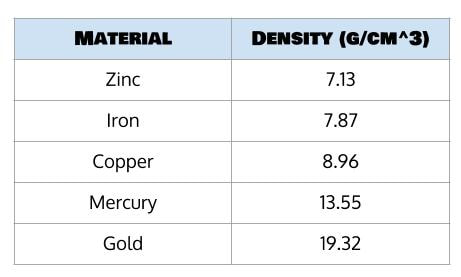
So let’s say that our block has a mass of 225 grams and a volume of 28.5 cm³. I know the usual density of these substances:
Picture
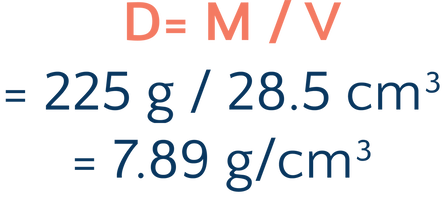
To solve this, we simply have to calculate the density of the block and compare it to the density of our known substances:
Picture
Factoring in just a little bit of rounding or measurement error, we can see that this is awfully close to the density of iron, which is 7.87 g/cm³. So, we still may not know why this mysterious cube fell out of the sky one day, but at least we know it’s made of iron. And isn’t there something comforting in knowing that something so unfamiliar is made of a very familiar element?

Rearranging the Equation

As with all equations, and Harry Styles, this equation doesn’t just work well in one direction. Let’s try working backwards with the equation. 

Let’s imagine that, now that the scientists in charge of the mysterious space cube know that it’s made of iron, they’re able to cut through it. Inside, they find a mysterious glowy, floaty light orb thingy:

Picture
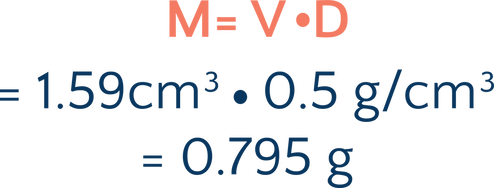
Oooohhh, mystery. Because the ball is floaty, the scientists are not able to measure the mass directly. But, in order to do further experimentation and find out more about the object, they need to know the mass. They are able to measure the density by light scatter with a laser and measure the volume by fluid displacement in a special chamber. They determine that the volume is 1.59 cm3 and the density is 0.5 g/cm³—light as a feather! What is the mass of this object?

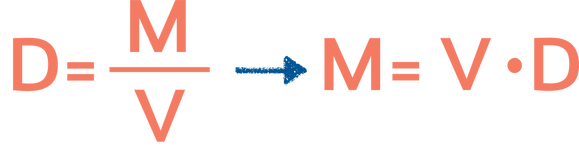
We can simply rearrange the formula for density to find out:
Picture
If you know any algebra, this rearrangement should make sense to you. If you don’t know algebra, you can use this handy triangle to help you out with the rearrangement:
So, calculating the mass of our mysterious orb:​
Picture
Wow, super light! Knowing this, they’re able to do further experimentation that brings them closer to understanding the mysterious origins of their orb.

Summary

You should know:
  • How to calculate density from a known mass and volume.
  • How to calculate mass from a known density and volume.
  • How to calculate volume from a known density and mass.
  • How to identify an unknown material by calculating density and comparing it to a list of known densities.
This does require some light math, but once you get the basics down, it’s pretty easy. Practice makes perfect!


Learning Activity

Picture
lesson 7: thermodynamics
lesson 6: Density eis

Content contributors: Emma Moulton and Emily Zhang
© COPYRIGHT 2020. ALL RIGHTS RESERVED.